Tuesday, February 06, 2007

Two Brothers and Their Cosmo

In the late 1960s, Japan was making great strides in recovering its pre-war industrial glory. However, abroad, and especially in the West, Japanese products were still thought of as cheap, poorly built, and just plain crap.

Two brothers in Japan, one in his early 20s, the other a few years older, pooled their life savings together and realized that they did not have enough to buy the ultimate Japanese sports car-- the Toyota 2000GT. So they bought the next best thing, the Mazda Cosmo. At $4,100 U.S., it was a lot of money for two underemployed men in what was essentially still a third world country. Suspicions that their parents chipped in for the car are probably accurate. Not much else is known about these two guys and their Cosmo.

What is less of a mystery is the Cosmo itself. It was the first Mazda fitted with a two-rotor Wankel engine. Mazda bought the rights to produce and develop the rotary engine from NSU of Gemany (a story for another blog). It had an astronomical (for its day) 7000 rpm redline and dubious reliability. To this day, Mazda has yet to come up with a durable, non-fussy, rotary engine.

The Cosmo, with a 92 1/2 inch wheelbase, had a cramped two-seat interior. The unusually tall brothers found it hard to drive, or sit in the passenger seat, comfortably. The 982 cc rotary engine produced an impressive 110 horsepower and 96 pound feet of torque. It was quick because it weighed just a tad over a ton.

The controversial design of the car certainly attracted attention for the brothers who owned the Cosmo. They probably enjoyed every moment of it. It also helped that the Cosmo was ultra-rare-- only one was built per day at Mazda's Hiroshima factory.

In writing and researching this, I have become more curious about these two brothers and their Cosmo. I think the next time I speak to the younger brother, I'm going to ask, "So, dad, what can you tell me about the Cosmo that you and your brother owned?"

CKY
M5 Uber Alles!

Over the past 25 years, there have been a lot of fast sedans from at least half a dozen carmakers, mostly from Europe. But one series consistently leads the pack in power, sophistication, dynamics, and yes, even affordability (relatively). That series: the BMW M5.

E28 (1984 to 1987)
The E28 got the M5 ball rolling. With a detuned twin cam inline six from the M1 mated to a 535i chassis, BMW gave the world the first M5. It became the fastest sedan in the world. Even by today's standards, almost a quarter of a century later, it is fast-- 60 mph in 6.2 seconds. A top speed of 153 miles per hour.

E34 (1988 to 1995)
BMW continued the tradition with the E34. They continued to be hand built. Legend has it that BMW's test drivers could tell which team built which cars because they all handled and performed slightly differently. To see how they perform under real life situations, look no further than the one featured in Ronin. It put the venerable 450SEL 6.9 and the newer S8 to shame.

E39 (1998 to 2003)
Of all the M5s, I coveted this more than any other. When it first came out, a guy who worked on the same floor as me had one. He admitted, sheepishly, that he never took it over 80 mph. Only decorum and grace kept me from slapping this guy in the face. Sacrilege! BMW will build better and faster M5s in five year increments, forever. But this will always be my favorite.

E60 (2006 to the present)
I know little about the latest iteration of the M5. Chris Bangle's influence (or mangling) is obvious. The performance numbers are impressive. For the overly paranoid or environmentally conscious, a dial offers 300, 400, or 500 hp on tap. There is an argument that there are so many gadgets and computer aids in this car, the car loses touch with the driver. The connection between car and driver is the very essence of BMWs. Maybe the E60 marks the end of M5 uber alles.

CKY

Friday, February 02, 2007

Antioch Kabob House: An Oasis In A Culinary Desert

Combo kabob entree, photo courtesy CoCo Times

Antioch, California, is not a foodie destination. In this blue collar exburb, fast food and chain restaurants proliferate and thrive. That's why when I drove by the town yesterday, I had the urge to try an Afghan restaurant I had read about, The Antioch Kabob House.

It is not in a great location. It sits at 1635 A Street, smack dab in the middle of a run down, anonymous strip mall between a Vietnamnese staffed nail salon and an anachronistic barber shop where the staff wear uniforms that are half military/half clinical technician.

I walk in at four p.m. for dinner. Of course, I am the only customer. At the far corner table sat a pair of young grandparents (the owners, I presume) and their granddaughter. They are watching her while her parents work. She is mesmerized by a Bollywood-style musical playing loudly on the big screen TV.

The grandmother and I chit chat. She does not recognize me as a regular so we talk about the menu and the restaurant. I put in my order and ask for a glass of water. She suggests the hot green tea. I comply.

Several pieces of homemade bread are offered with butter, a red chili sauce, and a mint chutney. Both the chili sauce and chutney were wonderful, but I found the bread too dry. I do not know if that is how it is supposed to taste.

I start off with the aushak appetizer. It is a stuffed pasta with sauce on top-- a cousin of the Italian ravioli, the Chinese jiaozi, and all the different local interpretations in between the two lands along the Silk Road. The pasta, which is a little too much on the wet/limp/overcooked side, is stuffed with leeks, scallions, and mystery herbs. The pasta is served, nee smothered, with a sauce consisting of tomato, tiny fine bits of ground beef, yogurt, and mint. Each bite was better than the last. I loved it. I was amazed by the portions. This $3.95 starter could easily be a meal for two light eaters.

Throughout the meal, I sip the green tea. Although the tea comes from a pre-packaged tea bag, it was a perfect pairing with the meal.

Then came the lamb kebab. Without hyperbole, it was the best lamb and best kebab I have had in a long time, if not ever. Eight large chunks of medium well lamb sat on my plate. Each chunk took two to three bites to finish. As I speared the meat with my fork, the natural juices flowed out. The lamb was extremely fresh, moist, tender, and perfectly cooked. But the secret is the sumac, a red spice with a sour taste, often used in Middle Eastern and Central Asian cooking, that coated the lamb.

The basmati rice served alongside was a story in itself. Because the owner knew I was new, she gave me both varieties of basmati rice on the side. One half was yellow, saffron infused. The other half was of the brown variety, probably cooked with beef stock. Both were light, fluffy, and yet satisfying. They were very filling.

The entree was completed with a side of salad-- unremarkable, supermarket-grade lettuce, tomato, and a ranch-like dressing.

Obviously, the kebab is the attraction here. But diners should not support this family restaurant just because of the quality of the food. They should support it because it opens doors to another world, another culture, in a town of corporate, franchised mediocrity.

CKY

Monday, January 29, 2007

The Blue Renntransporter

Race car transporters are bland and utilitarian by nature. Very rarely does a transporter attract more attention than the car it is carrying. When a transporter attracts more attention than the legendary W196 or 300SLR it is carrying, it is time to stop, stand back, and admire.

In the mid-1950s, Mercedes-Benz created a one-off transporter to carry its silver W196 and 300SLR racers. Called the Renntransporter ("race transporter" to us), it stirred more interest and commotion at the silver starred paddock than the famed race cars themselves.


The Renntransporter was an amalgamation of pre-existing Mercedes vehicles. The frame was from the 300S. The front and rear of the truck were stretched. The interior, including the checkered cloth seats, was borrowed from the 180 series. A detuned 300SL engine, from 215 to 192 horsepower, was transplanted. The SL's grill was also borrowed. Only the rear glass was created solely for the Renntransporter. The glass was designed so that it matched the aerodynamic profile of the W196 it often carried.

After the 1955 season, the Renntransporter was displayed at various venues, including the United States, for P.R. purposes. In fact, "Max. Speed: 105 m.p.h." was stenciled on the rear fender of the Renntransporter while it was briefly Stateside. It then sat in disrepair and was finally scrapped in 1967. In the ensuing years, tales of the Renntransporter reached epic, almost mythological proportions. A replica, based solely on anecdotes and black and white photos, was built in the 90s and unveiled at Goodwood in 2001. It took 6,000 man hours and seven years to complete. The only complaint about the new Renntransporter? It is bluer than the original.

I say-- Give the replicators a break; they had no color photos to work with!

CKY

Saturday, January 27, 2007

Rendezvous avec 450SEL 6.9

As I waited for three hours in a Tallahassee office lobby for an appointment that never materialized, my eyes caught a quick blurb in a dog eared car magazine about Rendezvous, a 1970s cult film lasting a little more than eight minutes.

When I came home, I learned more. C'etait un Redezvous was shot by filmmaker Claude Lelouch. He had just finished shooting a film with a gyro-stabilized camera mount. With the mount and ten minutes of film left, he decided to install it onto the front of a car and have it race through the streets of Paris at breakneck speeds. When French authorities turned down his request to close the streets down to make the movie, he took it upon himself to do it-- at 5:30 in the morning in August-- when traffic and pedestrians were at a minimum.

The film is surreal, sublime, and outrageous. The reckless disregard for human life exhibited is matched only by the skill with which the driver propelled his car through the streets of Paris. The Arc de Triomphe, along with anonymous, windy, and narrow cobble stoned streets all make their cameo appearances. The movie can be found with a quick search on youtube or google video.

For decades, this underground cult film has been the source of much rumor and speculation. One of the key questions is-- what kind of car was used? A Ferrari 275 GTB, an Alpine, a Benz 450SEL 6.9, and even a LeMan prototype, possibly a Matra, have all been suggested.

The leading theory is that Lelouch's own 6.9 was used with a Ferrari V12's engine sounds and tire screeches dubbed in. Although I would like to think that it was a 6.9, there are too many inconsistencies. First, the 6.9 was equipped with an anti-dive, anti-squat hydropneumatic suspension. Even with the gyro-mount, the car in the film dove and squatted too much like a conventional car, albeit with a tuned suspension, especially during turns and hard braking.

Second, although automotive journalist extraordinaires like David E. Davis likened the 6.9's agility to that of a Mini, the long wheelbased uber-saloon simply could not be as spritely as the car used in the movie. I had the privilege of learning to drive in a 1978 450SEL, sans 6.9, and it was like driving a bus. It would have been almost impossible to toss something that BIG around like a rag doll.

Ronin 6.9
Finally, despite its prodigious 6.9 liter V8 with 286 horsepower and 405 lb-ft of torque, and a zero to sixty time of 7.4 seconds, I don't think that it was quick enough to be the car in the movie.
Of course, all of this is speculation and conjecture. A recent photo popped up on the net showing Lelouch working on a gyro-mounted camera in front of a W116 bodied Benz. This may have resolved the question once and for all. If a 6.9 was indeed used in the movie, I must say that the movie just got even better.
CKY

Monday, January 15, 2007

The LM002: Ostentatious Ruggedness

So what do old-money Dutchmen, Uday Hussein, Hunter S. Thompson, and Vladivostok mafioso all have in common? They all own(ed) Lamborghini's uber-SUV, the LM002. Forget the AMG Gelandewagen or the Cayenne Turbo S. The LM002 was the original high performance, luxury SUV, preceding the aforementioned by decades.

The LM002 was created for armies of Middle Eastern autocracies, e.g. Saudi Arabia and Libya. Although these governments snatched up over 100 of these in total, with machine guns mounted in the back, they never caught on as a military vehicle.

Towards the end of its life, Lamborghini wanted to enter modified LM002s in the Paris-Dakar Rally. For financial reasons (supposedly), the project fizzled.

In the end, the notorious LM002 became an extension-- no, a badge-- of its infamous owners around the world. For the Dutch gentleman who got his fortune merely because his ancestors were astute middlemen, owning an LM002 in a cramped and expensive country known for bicycles represents his I-don't-give-a-shit-about-anything attitude and wealth. To Uday Hussein, Saddam's bloodthirsty son, ownership exuded his uncontrolled power.

Hunter S. Thompson, the father of Gonzo journalism, also owned an LM. And just like Thompson, the Lamborghini was profane. It was decadent. It was an exaggeration.

When I was little, I had a zebra striped Matchbox Cheetah, the LM's prototype. I would not see my first real life LM until 2005 when I happened upon one near the Geneva Airport. It was bigger than life. A beast. Monolithic. It was an LM002.

CKY

By the way, Uday's LM002, was confiscated by the U.S. Army and blown up to demonstrate the force of IEDs. It was not until the offending soldiers returned to the States and showed photos of the blown up LM that their more knowledgeable, car-savvy friends pointed out that they had destroyed a rare supercar. Kinda sums up our entire (mis)adventure in Babylon, no?

Miura: The First Supercar

The silver Miura I ordered from Canada just arrived. Aside from the currency exchange mix-up, the transaction went relatively smoothly. As I stare at my latest purchase, from every which angle, I must say this could be the most beautiful car ever made. Did I mention mine is a 1/43 scale Minichamps die cast model?

Inspired by the Ford GT40, the Miura established the first rule for all supercars: the engine must be in the middle. The idea of positioning the V12 sideways to save space was borrowed from the Mini Cooper. Other than that, the Miura is all original. The styling, by a 22 year old, is jaw dropping, even by today's standards. Just imagine what people thought when it rolled down the boulevard in the mid-60s.

The second rule for supercars was also established by the Miura: it had to be temperamental. The Weber carbs, while idling, often spat gasoline onto the hot engine, causing fires. Placing the gas tank up front meant that as fuel was consumed, the front end became lighter and harder to control. The list of mechanical, structural, and dynamic miscues can go on for a few more pages.

But all is forgiven. The bottom line on the Miura is its sheer exotic, unadulterated beauty. Bertone's lines could not be any more perfect. Even while parked for a photo shoot, it screams outrageous power, exclusivity, and delinquent behavior. As the Piedmontese exclaim when they see a beautiful woman: Countach!


CKY

Monday, January 08, 2007

5 Maui Eateries Worth Visiting

Hotel Hana Maui, Hana
The theme here is fusion. Ginger ahi. Hoisin BBQ quail. It is no better (and no worse) than the above average fusion restaurant in San Francisco or Manhattan, but it's all about location, location, location. After a long drive (or short flight) to Hana, the Hotel Hana Maui is a true oasis and mark of civilization. The view of the hotel grounds and the Pacific from the lanai makes the lunch even more savory and memorable.


Honokowai Okazuya, Kaanapali
Every regular condo renter along Lower Honoapiilani Road knows about this take-out joint. It serves Hawaiian lunch plates that are not only healthy, but tasty and sophisticated. Look no further than the mahi mahi with lemon capers. For 1/3 of the price of a similar entree at other restaurants, you get a generous portion of fresh mahi mahi. After the first bite of the flaky, tender fish with the tangy sauce, you realize that rumors that the Okazuya's owner used to be a chef at Mama's Fish House may just be true.


Honolua General Store, Kapalua
In the middle of Kapalua, where Tiger and Vijay vie for golf dominance every January and the rich and the wannabes spend their precious vacation days, sits Honolua General Store. Inside, you will find it always crowded with tourists loading up on kitschy souvenirs. But if you look carefully on the left end of the store, you'll see a cafeteria line serving artery busting lunch plates such as mac chili and beef with the obligatory scoops of rice and mac salad for under $7. You will also notice that while the store is filled with haole tourists, the lunch line is composed of locals-- hotel chambermaids, gardeners, and contractors. The food is authentic and delicious. But more important, it is a microcosm of overdeveloped West Maui and the uphill struggle by the working class locals to keep their traditional way of life.


Cafe des Amis, Paia
This is my favorite eatery on all of Maui. Once you cruise around for half an hour, find a parking spot, and slalom through the denizens of Paia (pot dealers/users, trust-a-farians, smelly hippies), you come to this quaint, clean, and charming little cafe. It specializes in two things, and two things only-- crepes and curries. I always go for the curries. The young chef in the back is constantly tinkering with the curry recipe. Everyday, it's a little different, but always extraordinary. The curry is served on a bed of white rice in a simple bowl. I am salivating right now, just writing this.

Mama's Fish House, Paia
This is a pretty touristy place and Visitor Channel 7 touts this place ad naseum. Ignore all the hype, go there, and judge for yourself. The ambiance inside is 1950s Hawaiiana with a modern touch. The freshness and quality of the seafood, the variety and creativity of the selection, the masterful execution and presentation-- all this makes Mama's the institution that it is. It's pricey, but well worth every penny, especially when enjoyed with family and friends.

CKY

Monday, January 01, 2007

Turkmenbashi's Successor

Last week, I was at a used book store and found a copy of Night Train to Turkistan, a story about a group of Americans who traveled by land to Turkistan, or Xinjiang Province in China. The cashier, upon seeing the book, said, "Whoa, didn't the president of Turkistan just die?" I replied: No, that is Turkmenistan, not Turkistan. I usually do not like to correct people because I don't want to come off like a smart aleck and I don't want the other person to feel bad. But on this occasion, I really felt it necessary to educate people about the differences between the "-stans". Our collective ignorance about Central Asia is so overwhelming, not even William Safire mentioned Turkmenistan last Sunday in a NYT magazine article in which he tried to list all the -stans.

Turkmenbashi

Of all the -stans, Turkmenistan is the most eccentric. Its personality cult, which is based around Turkmenbashi (Saparmurat Niyazov), is akin to that based around Kim Sr. and Jr. of North Korea. When Niyazov unexpectedly died of a heart attack on December 21, the big question was, who was going to take his place?

G.B. in center

In just a few days, the answer became clear. It was going to be Vice Premier Gurbanguly Berdymukhammedov ("G.B."). A one-time dentist, he is best known for closing all hospitals outside of the capital city because he, as the health minister, wanted to assure quality health care to all. Though that was a pretty bone-headed move, his machinations after Niyazov's death would make even Machiavelli proud. This is what he did to consolidate power:

1. Appointed himself the task of organizing Niyazov's funeral.
2. Under the constitution, the Parliament speaker was to succeed as interim president. G.B. immediately had the speaker arrested.
3. G.B. became interim president.
4. Under the constitution, the interim president is not allowed to seek the presidency. On Dec. 26, G.B. has the People's Council grant him the eligibility to run.
5. G.B. then has the People's Council unanimously nominate him for the presidency.
6. Simultaneously, G.B. has a law passed that bars citizens living abroad from running for the presidency. This effectively disqualifies all exiled opposition leaders.
7. The only viable opponent living within Turkmenistan that was not in jail was Nurberdy Nurmammedov. He was immediately arrested/disappeared.

Surprisingly, our government has been quiet through all of this. But I'm sure it has nothing to do with Turkmenistan's location (between Iran and Afghanistan) or the fact that it has one of the largest natural gas reserves in the world. Democracy, schmocracy.

Machiavelli smiling down at G.B.

Happy New Year!

CKY

Sunday, December 24, 2006

The Evolution of the Maserati Quattroporte

Since 1963, the Quattroporte has gone through five iterations. Its evolution has not been linear. Some were disasters while others have become coveted icons of Italian style. Here is a brief overview of the five versions.

(A really good resource is http://quattroporte.online.fr/ , which is run by a proud Quattroporte IV owner.)

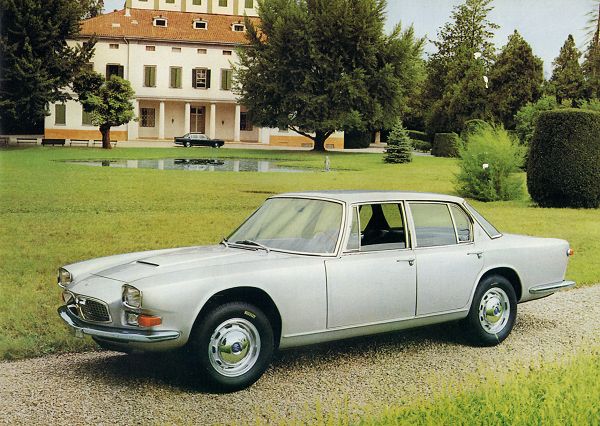
Quattroporte I (1963-69): The Rat Packer

If I were a betting man, I would wager that at least one or two Rat Packers had one of these puppies. A detuned racing engine was stuffed under the bonnet. The 4.1 liter V8 used all 256 horses to achieve an incredible 143 mile per hour top speed. Moreover, the styling equalled the awe-inspiring performance.

Quattroporte II (1974-78): The Flop

Only 13 of these were ever made. It shared many components with the Citroen SM, including the chassis, the hydropneumatic suspension, FWD set-up, and swivelling headlights. An asthmatic Merak V6 producing less than 200 horsepower was used. To put it simply: It just ain't right.

Quattroporte III (1976-90): The Icon

For most, this is the Quattroporte that comes to mind. It was meant to compete with the Benz 450SEL 6.9 (of recent Ronin fame). The controversial styling was a favorite among Italian magnates. If anything, it definitely stood out in the crowd.

Quattroporte IV (1994-2000): The Unremarkable

Though I am a pretty big car nut, this version of the fourdoor flew completely under the radar. I did not learn of it until very recently. Though it performed well on the road (it has a 158 mph top speed when coupled with the 330 hp V8), it looks like an anonymous Japanese sedan. Too much emphasis was placed on aerodynamics. No effort was made to connect it with its northern Italian roots.

Quattroporte V (2004-present): Turtle Chic

Aside from the jerky transmission, this sedan is perfect. When I saw Vincent Chase's Entourage ride in one, it was perfect. With a 400 horsepower Ferrari engine capable of reaching 60 in 5 seconds flat, this car not only looks fast. It is fast.

CKY